Return-to-play (RTP) decisions remain one of the most challenging responsibilities in elite sport.
Clear an athlete too early and you increase the risk of reinjury. Hold them back too long and you compromise performance, availability, and potentially the outcome of the season.
Despite advances in sports science, many RTP decisions still rely on a combination of experience, observation, and indirect performance markers.
While those are all still valuable insights, they often fail to accurately answer the most important question:
Is the athlete actually moving the same way they did before they got injured?
The RTP Problem As It Stands
Most current RTP protocols are built around a collection of established benchmarks:
- Time-based rehabilitation milestones
- Strength and power assessments
- Limb symmetry indices
- GPS running metrics
- Max speed exposure
- Subjective confidence and wellness scores
These measures help paint part of the picture, but they don't tell us exactly how the athlete is moving.
A player may hit 95% of their maximum sprint speed in training. Their force plate numbers may look acceptable, and maybe their strength ratios are within target ranges.
But that doesn't necessarily mean they are mechanically ready to compete.
Athletes are incredibly effective compensators. Following injury, they often find ways to achieve performance outcomes while subtly altering movement strategies to protect the affected area.
Those compensations may not appear in GPS outputs, wellness questionnaires, or even traditional strength testing. So the athlete appears "ready" on paper while underlying movement deficits remain hidden, unknown, and unmeasured.
This is one reason why reinjury rates in many field sports remain so high. The industry has become very good at measuring outputs, but has been less effective at measuring the movement mechanics that create those outputs.
What SprintAI Data Adds to Return-to-Play
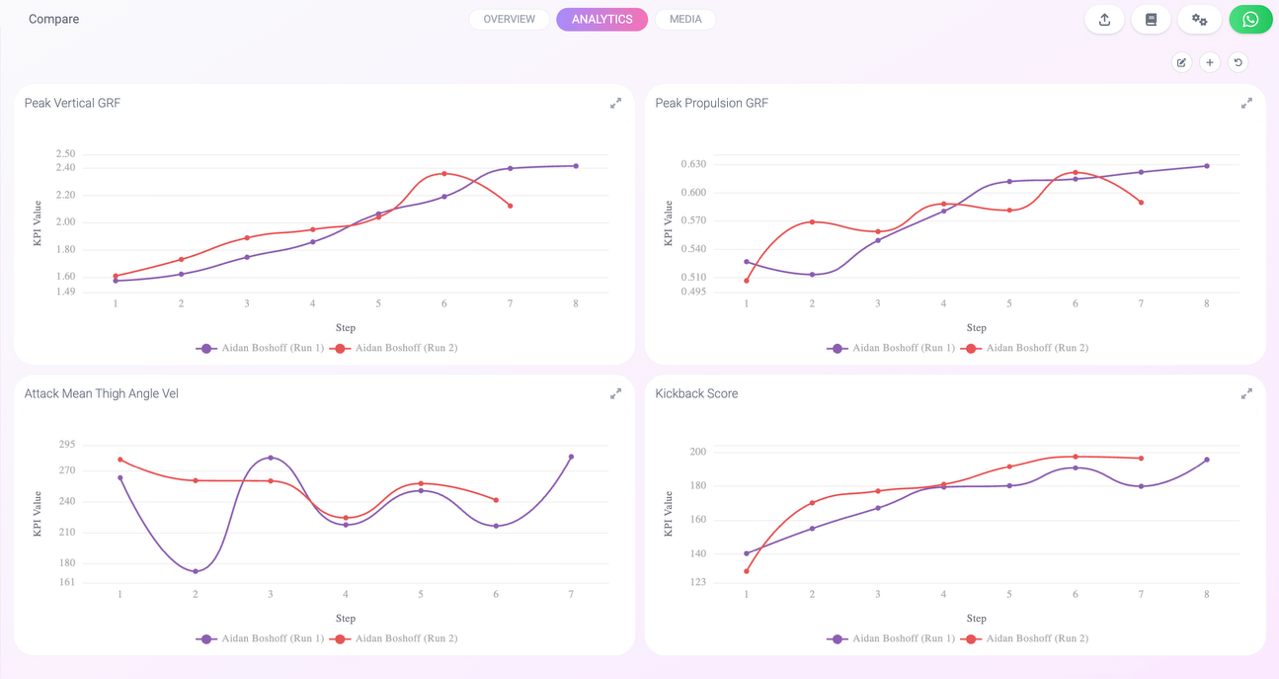
Forceteck's SprintAI provides a different layer of information by analysing sprint mechanics directly from video and generating objective kinematic and force-related metrics.
"For us, data is important because it allows us to be objective... any metric you can imagine, Forceteck has it. We can take that data back to a player and track the changes over time." —Jonathan Ward, Athletics Performance Coach @ Bristol Bears
Instead of focusing solely on what performance was achieved, coaches can understand how it was achieved.
This creates a few powerful opportunities within the RTP process:
1. Compare against a true baseline
One of the most valuable applications is comparing an athlete's current sprint mechanics against their pre-injury profile.
Changes in movement patterns can reveal whether an athlete is unconsciously protecting the injured side, altering force production strategies, or compensating elsewhere in the kinetic chain.
These are often the subtle differences that are invisible to the naked eye but can significantly influence reinjury risk.
2. Track asymmetry through the entire rehab journey
Asymmetries often fluctuate throughout different phases of recovery. The challenge for coaches is determining whether those changes are moving in the right direction.
SprintAI allows coaches to track asymmetry trends across rehabilitation phases rather than relying on isolated snapshots.
More importantly, it helps answer critical questions:
- Is asymmetry reducing over time?
- Has it plateaued?
- Is the athlete returning to their pre-injury movement pattern?
- Are new compensation strategies emerging?
Having objective answers to these questions creates a measurable, objective process for rehabilitation.
"Forceteck's data allows you to be far more precise. You can adapt exercises and field-based drills based on what the athlete actually needs, not just what you think they need." — Sam Scott, Owner & Founder of SSc Performance
3. Measure what GPS can't
GPS systems are excellent at quantifying external load and movement outcomes. What they don't reveal are the mechanical drivers underneath those outcomes.
That's why SprintAI provides access to metrics such as force-related outputs, joint and segment kinematics, and thigh angular velocities that are directly linked to sprint performance and movement efficiency. These insights help coaches understand whether the athlete's movement data (and the forces that cause those movements) are starting to match up with their pre-injury performance profile.
In many cases, those mechanical indicators provide a clearer picture of readiness than speed alone.
4. Complement existing RTP criteria
SprintAI is not designed to replace existing RTP frameworks. Strength testing, GPS monitoring, and subjective athlete feedback all still matter; the value comes from combining these traditional criteria with objective sprint mechanics data.
The benefit of SprintAI is that it can help explain why RTP measures do not always tell the same story. An athlete may have returned to their pre-injury GPS top-speed values, suggesting they are ready to progress, yet still report that they do not feel fully back to normal or comfortable sprinting. SprintAI may reveal that their sprint biomechanics remain altered, providing an objective explanation for the discrepancy.
By adding insight into how an athlete is moving, SprintAI helps reduce uncertainty, contextualise unexpected results, and support more informed RTP decisions.
"Before SprintAI, what we were doing was very basic biomechanics analysis that didn't give us confidence or clarity over some of the decisions we were making." — Michael Muckelt, Starts & Strength and Conditioning Coach, British Skeleton
Making Return-to-Play Objective and Defensible
Injury is inevitable. The opportunity to collect pre-injury data isn't.
Every season that passes without building objective athlete profiles is historical context that can't be recovered later. Teams that consistently collect sprint mechanics data over months and years develop a much clearer understanding of each athlete's normal movement profile.
Forceteck helps validate subjective observations by providing measurable movement data that can be exported, shared, and reviewed across departments. Medical staff, performance coaches, and management can all work from the same information, reducing uncertainty and creating alignment throughout the rehabilitation process.
By adding objective sprint kinematic data to the RTP process, everyone gains a clearer understanding of how an athlete is actually moving. Combined with existing medical, physical, and performance assessments, this creates a more complete picture of readiness that is measurable, defensible, and athlete-centered.
If you'd like to learn how Forceteck's SprintAI platform can support your return-to-play process, reduce uncertainty, and provide objective sprint mechanics data throughout rehabilitation, get in touch with a Forceteck expert today. Our team can show you how leading organisations are using SprintAI to make smarter, more confident RTP decisions and keep athletes performing at their best.